High-Speed Doors vs. Traditional Doors: Which Is Better for Businesses?
Choosing the right commercial door affects much more than how employees and vehicles enter a building. Door speed, durability, energy efficiency, maintenance requirements, safety, and traffic flow can directly influence everyday operations. For facilities with frequent movement, high speed doors are increasingly replacing traditional doors because they open and close rapidly while helping businesses maintain controlled indoor environments.
However, traditional doors still make sense for many low-traffic applications where opening speed and environmental separation are less important. The right choice depends on how your facility operates.
What Are High Speed Doors and Traditional Doors?
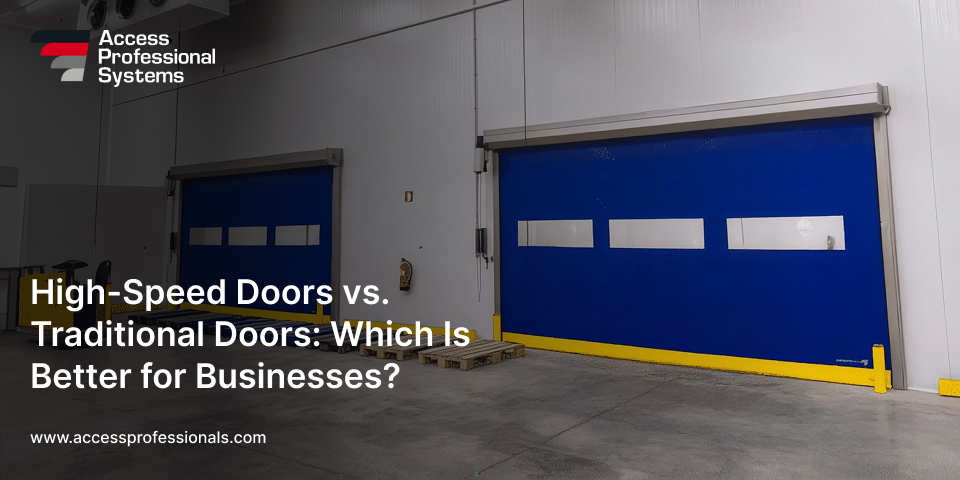
High speed doors are engineered to open and close much faster than conventional commercial doors. They are commonly installed in warehouses, manufacturing facilities, distribution centers, parking facilities, food processing environments, and other high-traffic locations.
Depending on the application, businesses may use high speed industrial doors, high speed rolling doors, a high speed overhead door, or specialized high-performance doors.
Traditional doors, by comparison, include conventional sectional, rolling, swinging, and overhead systems. They remain practical for entrances that are opened less frequently or where rapid cycling is unnecessary.
The fundamental difference between high speed doors and traditional doors is therefore not simply appearance. It is how effectively each system supports the facility’s traffic, environmental, safety, and operational requirements.
High Speed Industrial Doors vs. Traditional Doors: Key Differences
When comparing high speed industrial doors with traditional doors, businesses should evaluate the complete operating environment.
| Factor | High-Speed Doors | Traditional Doors |
|---|---|---|
| Opening Speed | Very fast | Generally slower |
| High-Cycle Operation | Excellent | Depends on door type |
| Climate Separation | Strong | Moderate |
| Traffic Efficiency | Excellent | Suitable for lighter traffic |
| Initial Investment | Typically higher | Typically lower |
| Best Application | Busy facilities | Lower-cycle entrances |
For operations where forklifts, employees, or vehicles continuously move between areas, speed doors industrial applications can reduce waiting and interruptions. A high speed overhead door can also remain closed for more of the day because each opening cycle takes less time.
1. High Speed Doors Improve Traffic Flow and Productivity
Opening speed becomes important when a doorway is crossed hundreds of times during a working day. Slow traditional doors can create bottlenecks as employees or forklift operators wait for the entrance to clear. High speed doors reduce that delay.
This is especially useful for high speed warehouse doors, where materials regularly move between receiving, storage, production, and shipping areas. Similarly, speed doors industrial facilities use can help keep production workflows moving with fewer interruptions.
A high speed garage door can provide similar benefits for vehicle-heavy service facilities. For larger commercial entrances, high speed commercial garage doors allow vehicles to move through efficiently while minimizing the amount of time the opening remains exposed.
For businesses where seconds accumulate into meaningful operational delays, high-performance doors can provide an important productivity advantage.
2. High-Performance Doors Can Improve Energy and Climate Control
Every time a commercial door opens, conditioned indoor air can escape while outdoor air enters. The longer an opening remains exposed, the harder HVAC or refrigeration systems may need to work.
Because high speed doors complete their cycles quickly, they can help reduce the duration of this air exchange. This makes high-performance doors especially valuable for climate-controlled warehouses, manufacturing environments, cold-storage areas, and facilities where temperature separation matters.
A high speed overhead door or high speed rolling doors can also help separate interior zones with different environmental requirements. By comparison, slower traditional doors may remain open longer during every cycle. That difference can become significant in a busy facility.
Businesses considering high speed warehouse doors should therefore evaluate potential operational and energy benefits alongside purchase price.
3. High Speed Overhead Doors Are Designed for Demanding Operations
Busy industrial environments place considerable stress on doors. Frequent opening and closing can accelerate wear when a system was not designed for intensive cycling.
High speed overhead doors and high speed industrial doors are specifically designed for demanding applications. Their construction and controls support repeated cycles while helping businesses maintain reliable movement throughout the facility.
This makes high speed overhead doors useful for distribution centers, manufacturing plants, logistics facilities, and other environments with constant traffic.
A high speed garage door may also be appropriate for commercial vehicle facilities where doors operate repeatedly throughout the day. Likewise, high speed commercial garage doors can support parking, automotive, and fleet operations requiring faster access.
The key is matching the door’s rated performance to actual operating conditions rather than simply replacing one of your traditional doors with the closest available model.
Roll Up Door vs Overhead Door: Which Configuration Is Better?
The roll up door vs overhead door comparison depends heavily on available space and facility requirements.
A rolling door typically coils its curtain above the opening, while sectional overhead doors generally travel along tracks. When considering roll up door vs overhead door options, businesses should evaluate ceiling clearance, opening dimensions, traffic volume, maintenance accessibility, security, and operating speed.
High speed rolling doors can be particularly useful where rapid cycling and efficient use of space are priorities. Meanwhile, high speed overhead doors may suit facilities requiring specific insulation, dimensions, or operating characteristics.
High Speed Warehouse Doors vs. Traditional Doors: Which Should You Choose?
For low-traffic storage areas, utility rooms, and entrances used only occasionally, traditional doors may remain the practical and economical choice.
For busy warehouses and industrial environments, however, high speed warehouse doors offer several potential advantages. Faster operation can improve traffic flow, reduce exposure between environments, and support high-cycle workflows.
Similarly, businesses considering speed doors industrial applications should evaluate:
- Daily door cycles
- Forklift and pedestrian traffic
- Temperature requirements
- Opening dimensions
- Safety requirements
- Maintenance expectations
- Long-term operating costs
For vehicle entrances, high speed commercial garage doors or a high speed garage door may offer greater operational value than conventional systems when traffic volumes are consistently high.
Why Choose Access Professional Systems for High Speed Doors?
Choosing between high speed doors and traditional doors requires more than comparing specifications online. Door size, facility layout, traffic patterns, environmental conditions, and safety requirements all influence the right solution.
Access Professional Systems helps businesses evaluate and implement commercial door solutions based on their actual operational requirements. Whether your facility needs high speed industrial doors, high speed rolling doors, high speed overhead doors, or high speed commercial garage doors, professional system selection and installation can help maximize long-term performance.
Access Professional Systems can also help businesses navigate the roll up door vs overhead door decision and identify high-performance doors appropriate for warehouses, manufacturing facilities, parking operations, and other demanding commercial environments.
Wrapping it Up!
Neither high speed doors nor traditional doors are automatically right for every business. Facilities with limited traffic may find conventional systems perfectly adequate, while high-volume operations can benefit significantly from faster, more durable door technology.
For warehouses, distribution centers, manufacturing environments, and busy vehicle entrances, high speed industrial doors, high speed warehouse doors, and high speed overhead doors can improve traffic flow and environmental control.
The best approach is to assess your door cycles, traffic, building conditions, and long-term operating requirements. Access Professional Systems can help determine whether high-performance doors or conventional solutions provide the better fit for your facility.
Frequently Asked Questions
Are high speed doors better than traditional doors for warehouses?
For high-traffic facilities, high speed doors can offer advantages over traditional doors because their faster cycles reduce waiting and limit how long openings remain exposed. High speed warehouse doors are particularly useful where forklifts and materials move frequently between operational areas.
What is the difference between a high speed overhead door and a regular overhead door?
A high speed overhead door is designed around rapid opening and closing and typically supports demanding operational cycles. Conventional overhead doors generally operate more slowly. The best option depends on traffic frequency, environmental requirements, opening size, safety needs, and budget.
How do I decide between a roll up door vs overhead door for my business?
When evaluating roll up door vs overhead door configurations, consider available headroom, opening dimensions, security, insulation, operating frequency, maintenance, and required speed. High speed rolling doors can be especially attractive for facilities prioritizing rapid cycles and efficient use of space.
Are high speed commercial garage doors worth the additional investment?
High speed commercial garage doors can justify their higher initial investment when frequent vehicle movement makes faster access valuable. Reduced waiting, shorter exposure times, and high-cycle capabilities can provide meaningful operational benefits for parking facilities, service centers, fleet operations, and other busy entrances.
Where can businesses get professional high speed industrial door installation?
Businesses should work with an experienced commercial door provider that can evaluate traffic, opening dimensions, safety requirements, and environmental conditions before recommending equipment. Access Professional Systems provides solutions for high speed industrial doors, high speed overhead doors, and other commercial applications.
Share: